Idea Genius:
AI-Powered Startup Platform
The Startup Journey is Broken
Launching a startup requires expertise across a dozen domains — legal formation, branding, product design, financial modeling, marketing, fundraising. First-time founders either spend six to nine months figuring it out through trial and error, or they pay $50,000+ for consultants to walk them through it.
The tools exist, but they're scattered. A founder uses one app for business planning, another for brand design, a spreadsheet for financial projections, and a Google Doc for their pitch deck. Nothing connects. Each tool starts from zero with no awareness of what the founder has already decided.
The idea behind Idea Genius was to build a single platform that guides founders through the entire startup journey — from the first spark of an idea through an investor-ready pitch — with AI that remembers every decision and builds on it at every step. Not a collection of AI tools. A connected system where the branding step knows what the business vision step decided, and the pitch deck knows what the financial model projected.
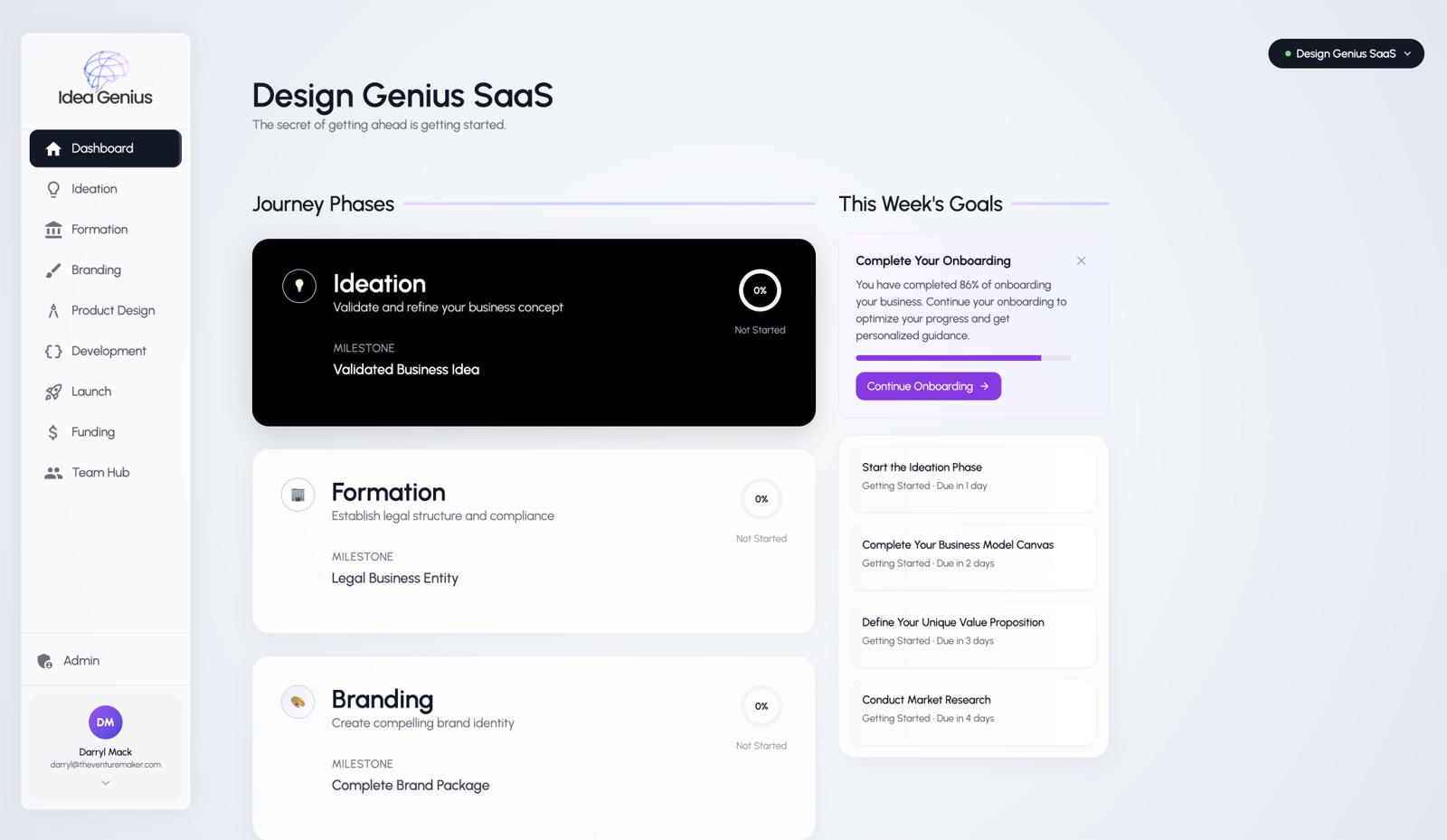
The dashboard shows the full startup journey — seven phases from Ideation through Funding, each with milestone tracking and weekly goals that keep founders moving forward.
Three Layers. One Connected System.
The core challenge was depth. This isn't a single-purpose app — it's a system with four levels of navigation: journey, phase, step, and tool. A founder moves through seven phases, each containing multiple steps, and each step containing its own set of tabs — overview, action plan, AI tools, file management, and conversation. That's 49 steps with unique content, unique AI interactions, and unique deliverables, all needing to share context.
The architecture that made this manageable is built on three layers. The first is the Journey Framework — a comprehensive information architecture mapping every phase, step, and deliverable with defined inputs and outputs. The second is the AI Integration Layer — a config-driven system where each step defines its own prompt template, response schema, and RAG configuration in a JSON file. The third is the Collaboration Engine — real-time task tracking, file management, and team workflows powered by Firebase.
The config-driven approach is the critical architectural decision. Each of the 49 steps is defined by a JSON configuration that specifies what the AI should do for that step — what system message to use, what prompt template to fill, what response format to expect, and what prior decisions to pull in as context. Adding a new step or modifying an existing one is a data change, not a code change. The application logic stays the same; the configuration drives the behavior.
Three-Layer Architecture
Config-Driven AI OrchestrationThree layers, cleanly separated. The Journey Framework defines what to build. The AI Layer defines how AI helps at each step. The Collaboration Engine handles everything human — tasks, files, and team communication.
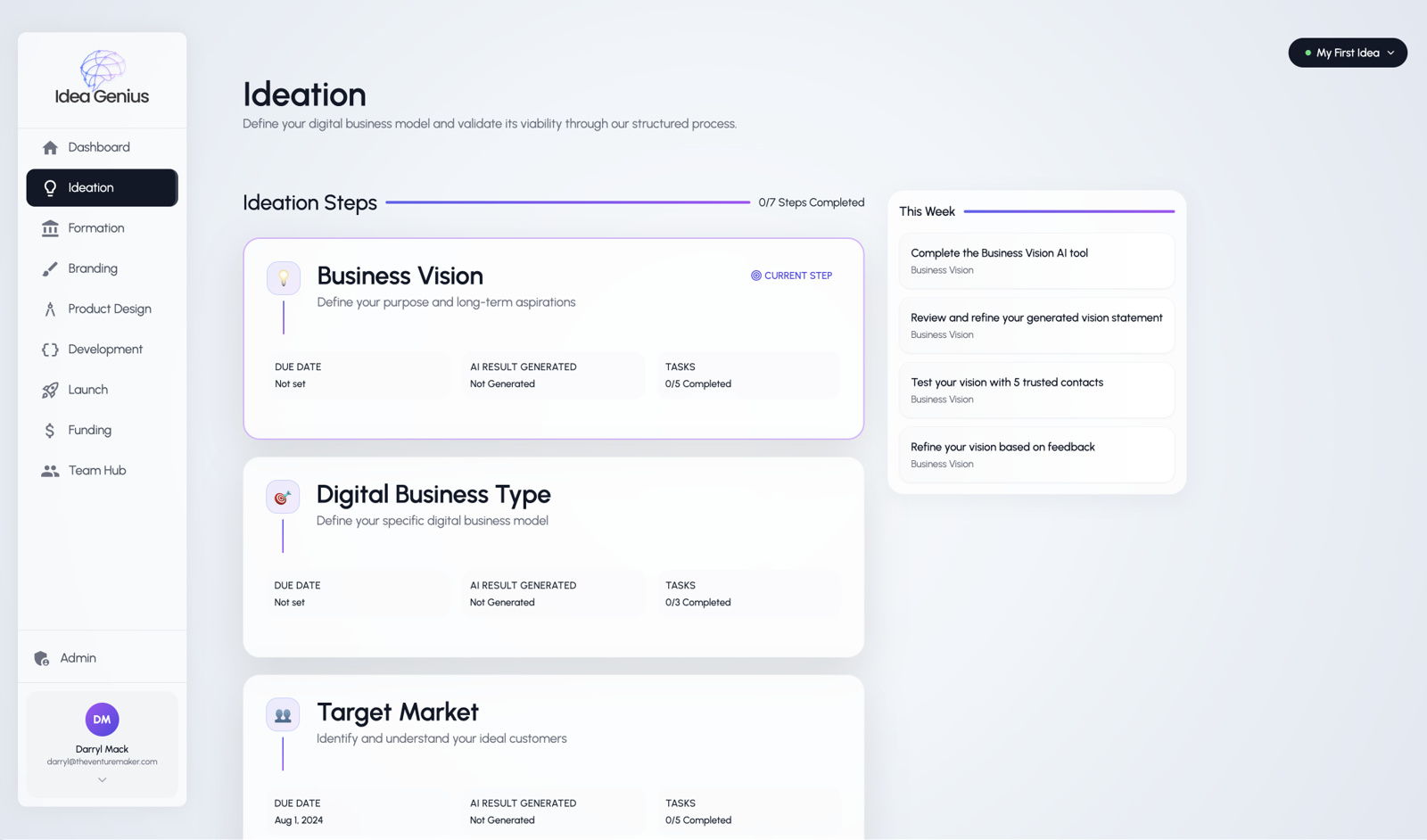
Each phase contains multiple steps — Business Vision, Digital Business Type, Target Market — each with its own due date, AI result status, and task count. The architecture supports 49 of these, all sharing context through the RAG pipeline.
AI that Remembers Every Decision
The difference between Idea Genius and a collection of AI tools is context. When a founder reaches step 35 — say, building a pitch deck — the AI doesn't start from scratch. It pulls in the business vision from step 1, the target market analysis from step 5, the competitive positioning from step 12, the financial projections from step 28, and the brand voice from step 18. Every prior decision becomes context for every future interaction.
This is the RAG pipeline at the heart of the platform. Each step's configuration defines which prior results to retrieve and inject as context. The prompt template for each step is designed to consume that context meaningfully — not just appending previous answers, but weaving them into specific instructions that produce coherent, connected outputs.
The config-driven approach means the AI integration for a new step is a JSON file, not a feature build. The step defines its system message, its prompt template with placeholder variables, its response schema for structured output, and its RAG configuration specifying which prior steps to pull context from. One API route handler processes every step — the configuration tells it what to do.
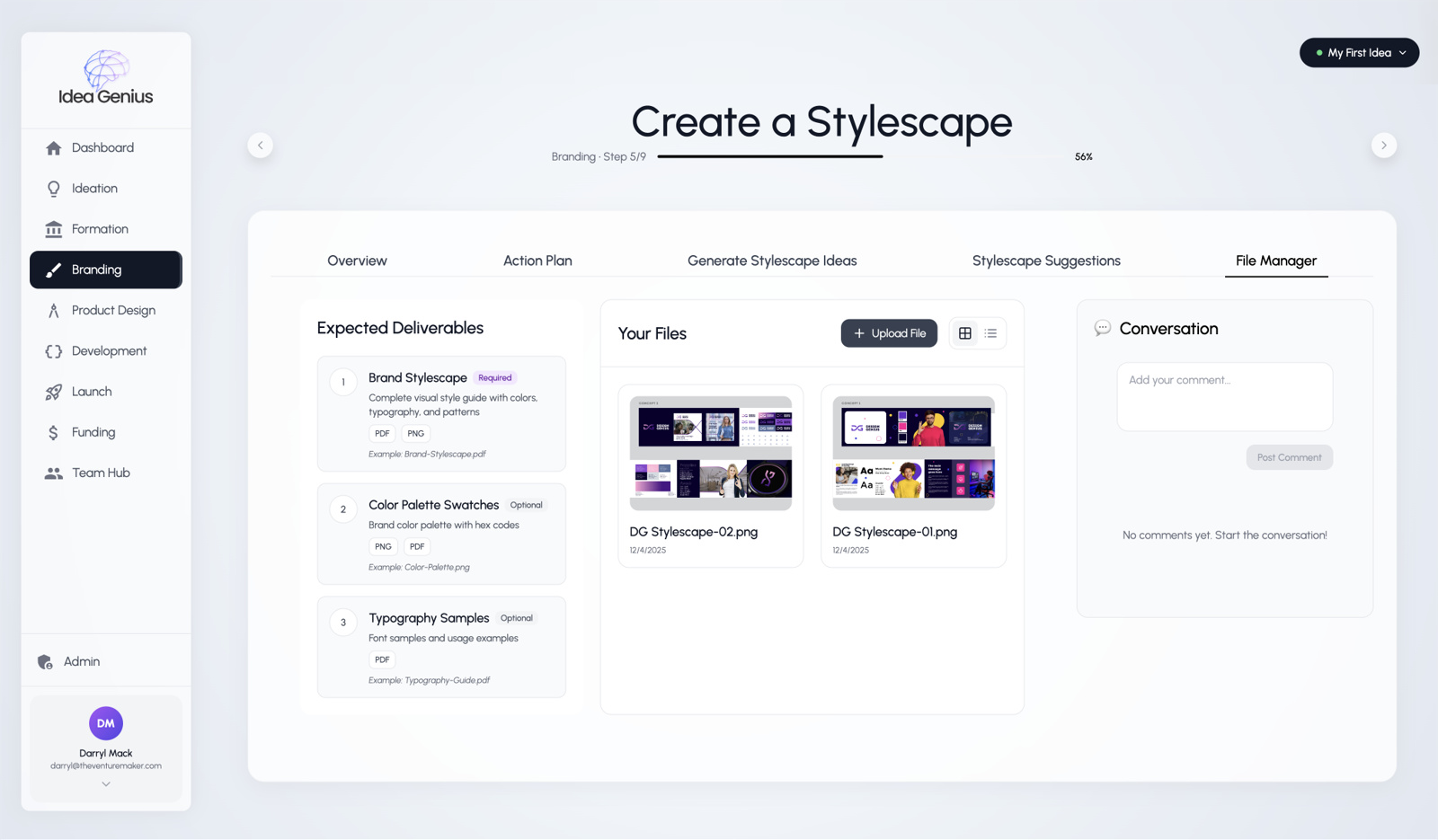
Inside a single step — Create a Stylescape. The AI generates brand direction based on every prior decision about the business. The file manager holds uploaded assets. The conversation panel enables team discussion. All in one view, all connected.
Threaded context
Every AI interaction draws from the full history of decisions the founder has made. Step 35 knows what step 1 decided. The pitch deck knows what the financial model projected. Nothing starts from zero.
Config-driven orchestration
Each step's AI behavior is defined by a JSON configuration — prompt template, response schema, system message, and RAG settings. Adding a new AI-powered step is a data change, not a code change.
From Spark to Pitch Deck
Idea Genius shipped as a complete platform — not a prototype with a few AI features bolted on. Founders sign up, create a project, and move through seven phases with 49 guided steps. Each step has its own AI tools, deliverable checklists, file management, and team conversation. The dashboard tracks progress across every phase with weekly goals that keep the journey moving forward.
The Team Hub brings collaboration into the platform. Founders assign tasks to co-founders and advisors, track completion across the entire project, and manage priorities without leaving the system. File management supports version control and preview for common file types. Everything a founding team needs to go from a raw idea to an investor-ready business lives in one place.
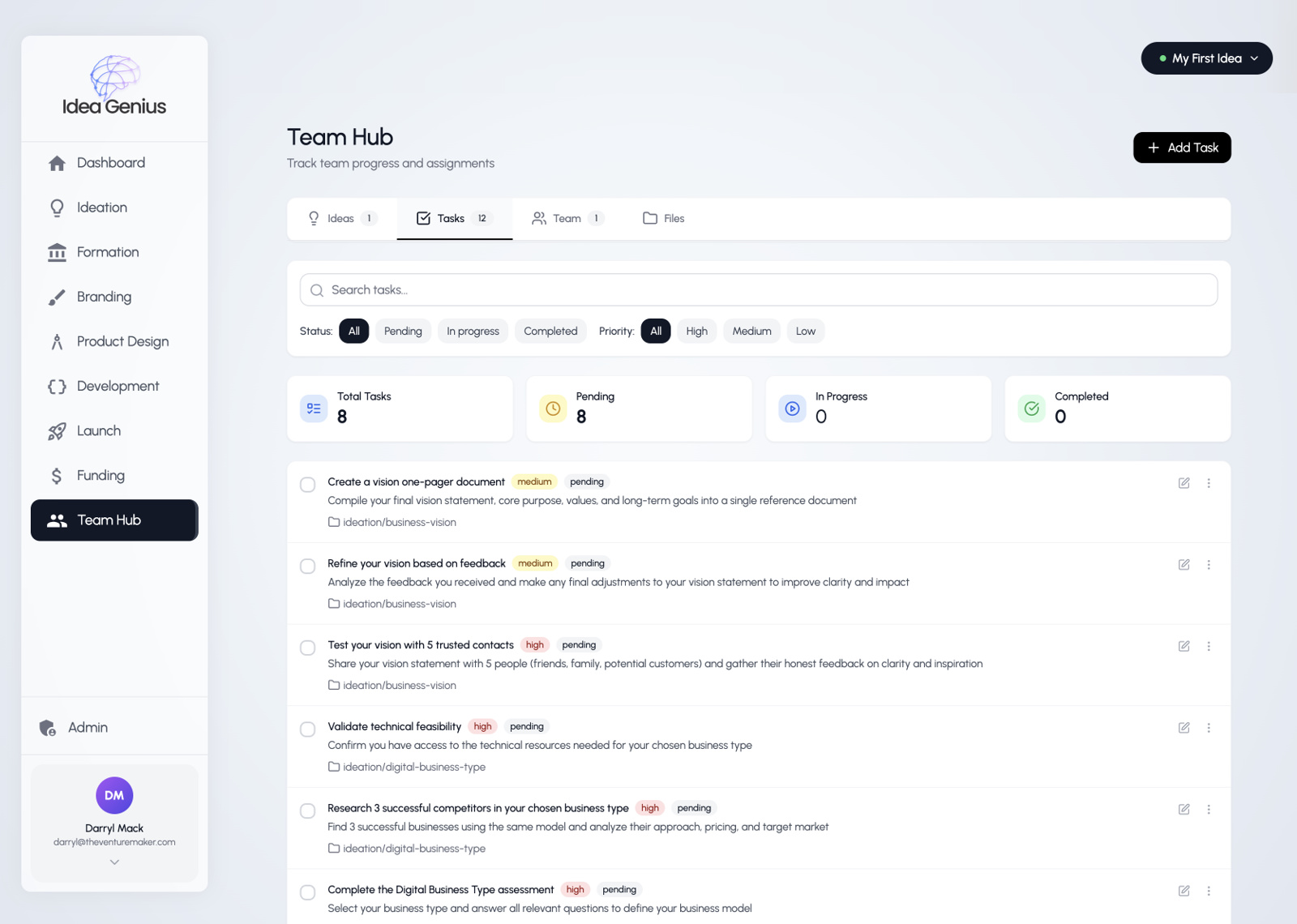
The Team Hub — task management, status tracking, and priority filtering across the entire startup journey.
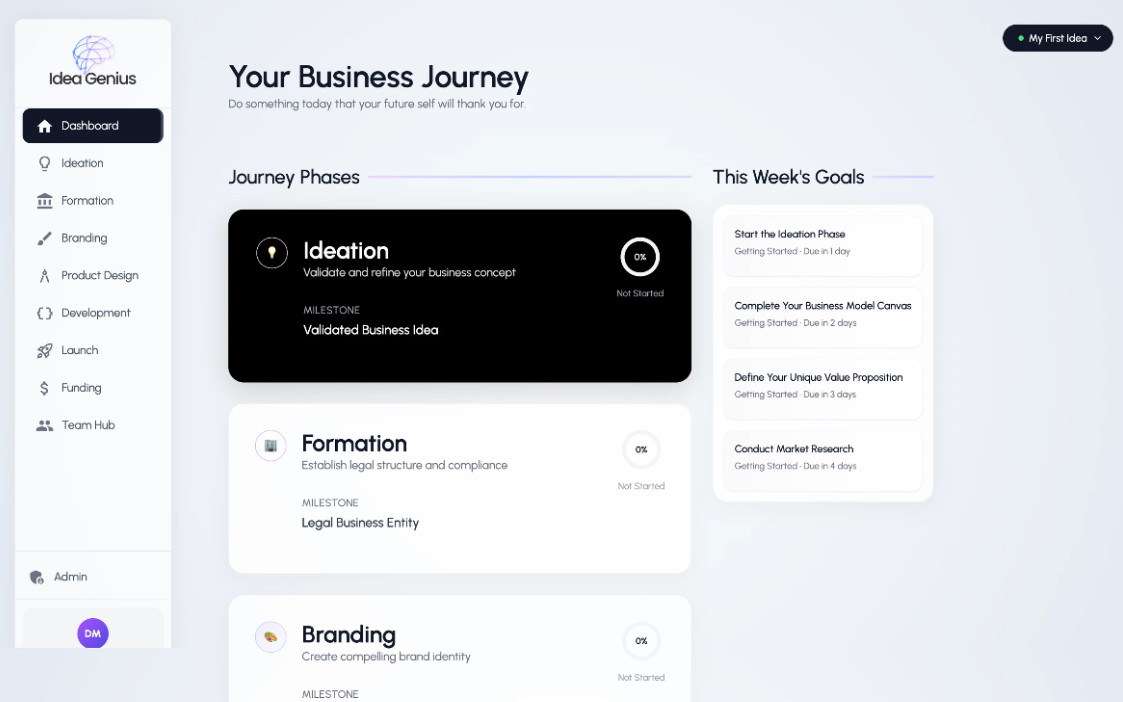
The journey view — seven phases from Ideation to Funding, each with milestone tracking and completion percentages.
What Shipped
Auth, onboarding, AI-powered guidance, task management, file versioning, team collaboration, progress tracking — a complete platform where every AI interaction builds on every prior decision.